Eserp's mission is to offer superior education that is high in quality and content, cutting-edge, and decidedly contributory, serving society while always prioritizing student interests. The institution serves modern society by offering high-quality, content-rich education. This education is based on updating its teachings through research and the development of theoretical and empirical analyses of the current business reality.
Eserp's pluralistic option aligns with the ethical and moral values that have characterized it since its inception and continue to be part of its current and permanent mission, where the spirit of improvement, work, and dedication it offers is an indispensable foundation.
As an affiliated centre of the University of Vic – Central University of Catalonia (UVic-UCC), eserp currently offers several official undergraduate degrees in Barcelona. Eserp's quality policy, as an affiliated centre of UVic-UCC, implements and adapts the Internal Quality Assurance System (SGIC) model of this University.
For practical application, UVic-UCC has an SGIC on which it bases the continuous improvement of its processes, with improvement plans and analysis of the satisfaction of the stakeholders it serves. The quality system of UVic-UCC, which eserp implements and adapts, is organized based on the definition of strategic, key, and support processes according to the continuous improvement cycle that describes the basic stages of the virtuous circle to achieve total quality: plan, do, evaluate, improve, and provide accountability. Therefore, UVic-UCC — with the collaboration of eserp as an affiliated centre — continuously evaluates, redesigns, and implements the mechanisms and instruments of the SGIC according to this policy, gradually incorporating this understanding of quality at all levels of the institution and in all its activities.
Eserp is organized in a way that allows for the correct development and fulfilment of quality assurance objectives. The management team of the centre: The management team generally assumes the responsibilities indicated in the various quality assurance system documents and specifically:
As a demonstration of its commitment to quality management, eserp's management team develops and implements quality assurance systems in the centre, in accordance with the guidelines proposed by the University, as well as the continuous improvement of the same. Consequently, all individuals at eserp involved in processes are engaged to act diligently and carefully to prevent a deterioration of the quality of the services provided.
Therefore, eserp's management team:
The Quality Coordinator:
The Quality Coordinator is the person delegated by the management team to the Eserp Quality Commission. Their main mission is to advise the management team on the design, implementation, maintenance, and improvement of the quality assurance system.
The Quality Coordinator has the following functions:
The Eserp Quality Commission:
The Commission is the body responsible for quality processes related to the centre’s degree programs. It ensures quality in the planning and deployment of verification, follow-up, modification, and accreditation processes for official undergraduate and master's degrees taught at the centre, as well as SGIC processes.
The Commission consists of:
The Commission has the following functions:
External regulations:
Internal regulations:
The European Higher Education Area (EHEA) and changes introduced in the legal framework stipulate that universities must ensure in their actions the fulfilment of objectives associated with the degrees they offer while striving for their continuous improvement. In this context, eserp, as an affiliated centre of UVic-UCC, has deemed it necessary to implement and adapt the Internal Quality Assurance System (SGIC) of this University in its undergraduate and master’s degrees, to enhance the quality and continuous improvement of the programs and services it provides.
In this sense, the SGIC addresses two basic questions:
The principle inspiring the objectives to be achieved by the SGIC is to provide assurance to students and society that the undergraduate and master's programs offered by eserp, as an affiliated centre of UVic-UCC, are of high quality. Consequently, the quality assurance system has established the following specific objectives:
The SGIC is designed to ensure the quality of all undergraduate and master's degrees taught at ESERP, as an affiliated centre of UVic-UCC, addressing all dimensions of teaching quality. In this regard, the SGIC complements the research quality model and the management and services quality model of ESERP.
In defining the mechanisms of quality assurance for teaching, the system covers the following areas:
Regarding the design of the educational offer:
Regarding teaching development and other actions aimed at students:
Regarding PDI and PAS:
Regarding services and material resources:
Regarding training results:
Regarding public information:
The UVic-UCC has had the Internal Quality Assurance System implemented since 2010 and certified by AQU Catalunya within the AUDIT program.
All UVic-UCC centres assume a common SGIC model, which includes transversal processes that depend directly on the university's central services and are common and general to all UVic-UCC centres and others managed by each foundation or affiliated centre.
In this regard, eserp has assumed the transversal processes of the UVic-UCC sphere and, in the 2022-2023 academic year, has begun working on migrating centre processes to the new system version, which is expected to be approved by theeserp Quality Commission in the 2023-2024 academic year.
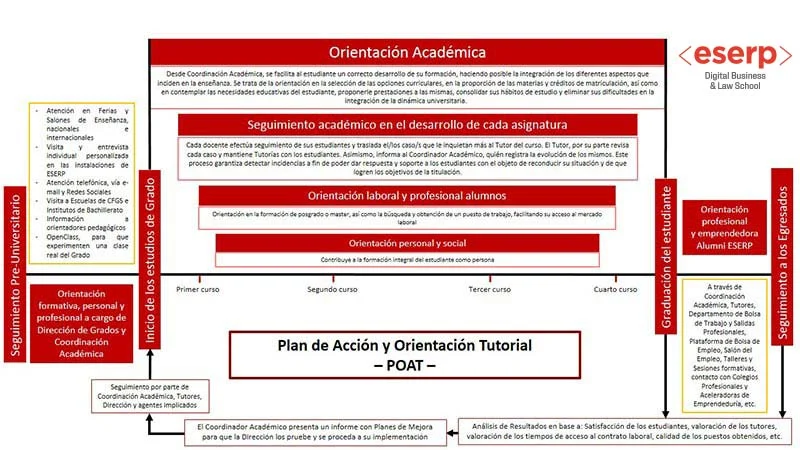
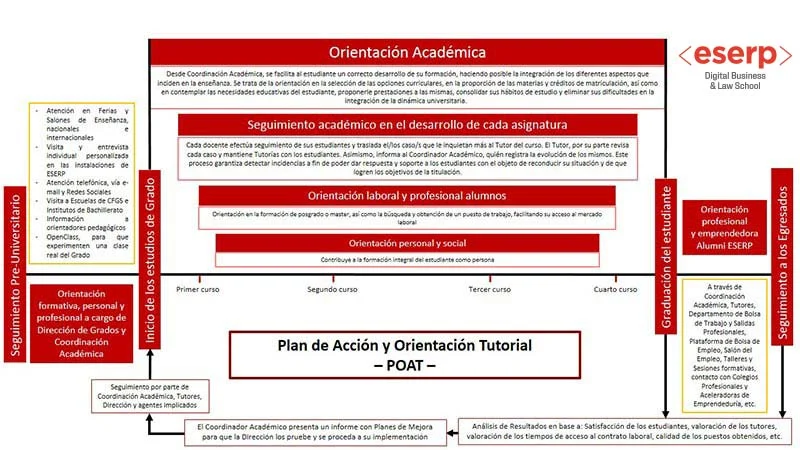
Since the implementation of the currently verified degrees, Eserp has been developing its own Tutorial Action Plan, which has now been renamed the Guidance and Tutorial Action Plan (POAT) and was approved by the General Management on 9 January 2023.
This new plan is based on the POAT of the University of Vic – Central University of Catalonia, which allows for better attention to the needs of students in different teaching modalities, responds to a greater diversification of their needs and their consequences, and also allows the institution as a whole to work in a more coordinated manner to promote improvements in training and learning conditions or in the detection, attention and/or referral of situations that may negatively interfere with the training and personal and professional development processes of students.
Eserp's guidance and tutorial action is approached on two different levels. Firstly, priority is given to a model of tutorial action integrated into teaching and, secondly, beyond what is offered as part of teaching activities, a set of specific actions are developed that allow for comprehensive attention to be given to students from the moment they enrol in their studies, throughout their training and, finally, in terms of the link they establish with the institution once they have completed their Bachelor's or Master's degree.
This guidance and tutoring action includes support for students in three specific areas: academic, personal and social, and, thirdly, employment or professional.
For further information, you can download the complete POAT at the following link.
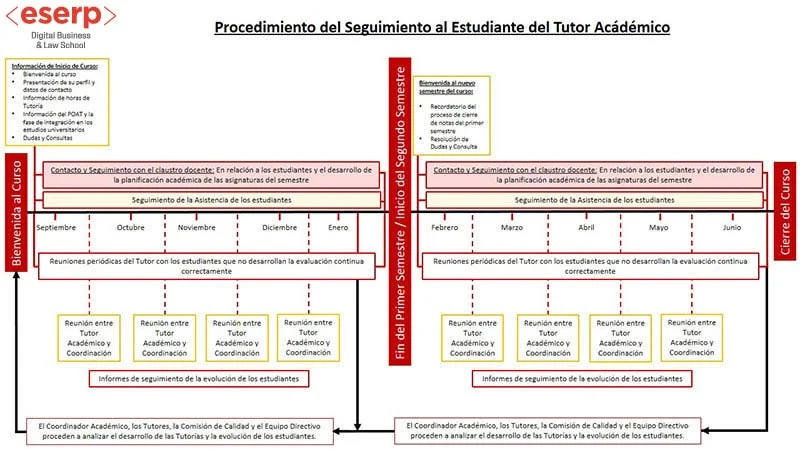
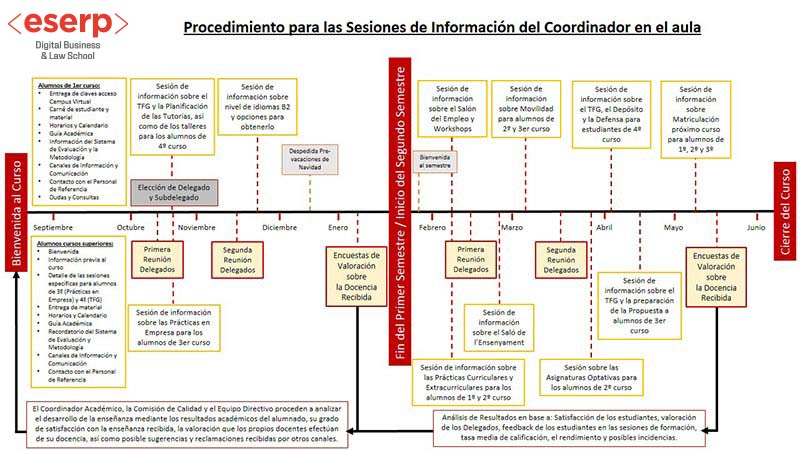
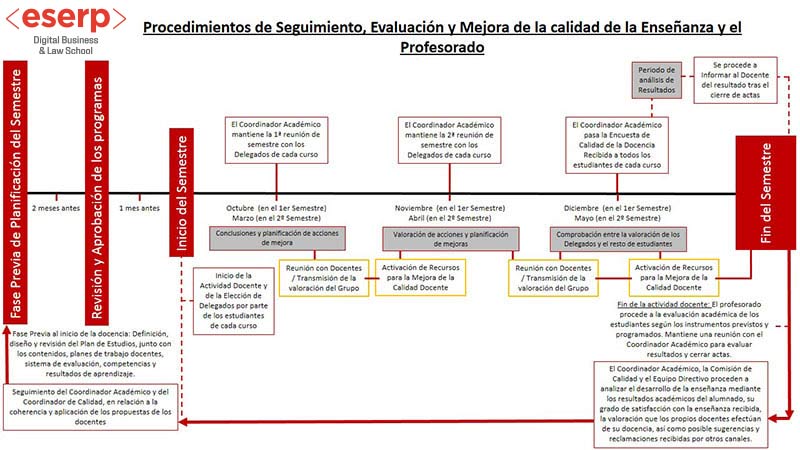
Procedure for evaluating and improving teaching quality: After defining, designing, applying, and managing the curriculum, the teaching activity is developed according to the forecasts and agreements reached. At the end of this activity (once per semester), faculty members proceed to academically evaluate the students using the instruments planned and programmed. Subsequently, the management team, with the support of the Eserp Quality Commission, conducts an analysis of the teaching development subprocess, considering the academic results of students, their satisfaction with the received education, as well as possible suggestions, complaints, etc., received through appropriate channels. This information forms the basis for monitoring, measuring, and improving the subprocess in question.
On a semi-annual basis, the centre’s management team promotes the monitoring, measurement, and improvement phase of the teaching development subprocess. For this, they consider the received incidents, the results of student satisfaction evaluation surveys, and strategic indicators such as:
Returning to student satisfaction surveys, they are conducted for all faculty members, subjects, courses, and degrees, on a semi-annual basis. Their results are analysed by the eserp management team.
As a result of the analysis, the management team, with the participation of the Quality Commission, drafts a monitoring report with proposals for process improvement. This report is sent to the Eserp Quality Commission for approval and validation to proceed with the implementation of the proposals it contains.
For dissemination, the centre’s management team ensures correct information channelling among the groups of interest and the responsible parties involved in the process (through appropriate means) of the data generated as a result of its application.
Periodic revision and improvement of the centre’s degrees begin when modifying existing study plans becomes indispensable for their constant adaptation to societal needs and students.
For this reason, annually, the centre’s management team receives pertinent suggestions, concerns, complaints, and proposals from the stakeholders involved in academic activities. After selecting this information, it is forwarded to the Eserp Quality Commission, which analyses and evaluates it, as well as monitors the study plan to draft an annual (at the end of the course) global report for the centre’s management team and university officials with the appropriate results and recommendations. Based on the analysis of the global report, the centre’s management team develops Improvement Plan to be implemented at the start of the course.
Following the approval of the Improvement Plan, the centre’s management team submits it to the University Quality Commission for approval, and once approved, proceeds to disseminate it to the involved stakeholders for implementation.
Annually, the Eserp Quality Commission assumes the monitoring of this process. To do so, it reviews the implementation, acceptance, and effectiveness of improvements planned in the approved Improvement Plan. Finally, it includes the obtained results, observations, and proposals in the new global report for the centre’s management team to consider in developing the new Improvement Plan.
To disseminate this process, the centre’s management team, along with the Eserp Quality Commission, ensures correct information channelling among the involved stakeholders and through appropriate means for the Improvement Plan of degrees approval, application, and review for enhancement.
Procedure for evaluating and improving faculty quality: Eserp has a procedure to evaluate and improve faculty quality. This procedure applies to all Official Degrees offered by eserp. Its development is executed semi-annually through meetings by the centre’s management team with all PDI involved in teaching the programs. Such meetings analyse all faculty quality improvement actions conducted by eserp faculty. The results serve as evidence for improving teaching activity and possible PDI promotion. This procedure's follow-up, measurement, and improvement will be conducted through the Eserp Quality Commission, which will include a summary of the teaching evaluation processes and potential applicable enhancements in its annual report. If necessary, the centre’s management team will transmit these suggestions to the eserp General Management for subsequent modification.
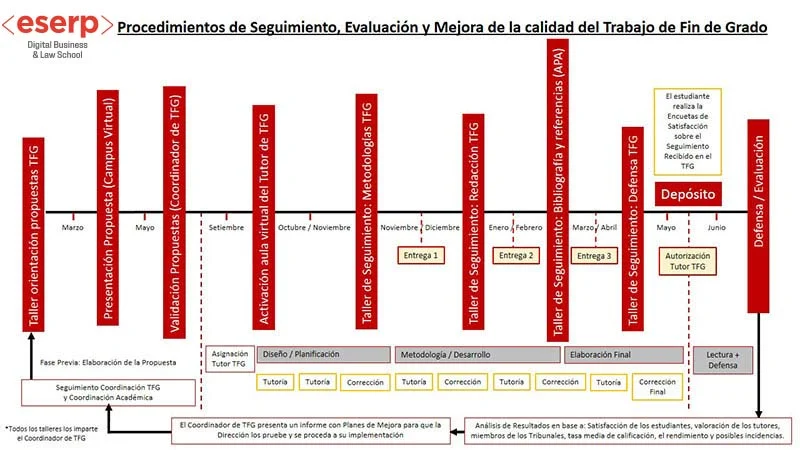
Procedure to ensure external internship quality: This procedure is relevant for undergraduate and master’s degrees that involve student participation in external professional internships or require them to develop final career projects based on external professional internships.
After defining, designing, offering, promoting, and managing any external internship programs, a faculty tutor is assigned to the student for their internship; similarly, a professional tutor from the host company or institution is assigned for the internship. The faculty tutor and the professional tutor design the internship work plan according to the objectives and specific competencies required by the student’s training needs; likewise, they provide necessary documentation containing general guidelines and general and specific information required for adequate internship completion. During the internship, and according to criteria set by the centre, the faculty tutor conducts academic monitoring, ensures optimal utilization, and guides the student to obtain the best possible results (for this, any relevant aspects occurring during the internship are recorded in a monitoring report). The professional tutor from the internship company or institution also monitors the student and records observations and evaluations in a report. At the internship period's end, the student is evaluated according to the centre’s criteria, always considering the monitoring reports of the faculty tutor and professional tutor. Similarly, the centre’s administration recognizes the internships as credits.
Finally, the monitoring, measurement, and modification of the external placement programme are conducted when the Centre’s External Internship Coordinator analyses the placement process to ensure it meets the established objectives and to modify, correct, improve, or eliminate any detected anomalies. The External Internship Coordinator will base their analysis on indicators such as:
After identifying the process's strengths and weaknesses, the External Internship Coordinator consults with implicated agents (faculty tutor, professional tutor, involved students) and the Eserp Quality Commission to craft appropriate improvement proposals. Such proposals are submitted to the centre’s management team for approval. Subsequently, approved proposals are implemented under the Eserp Quality Commission's monitoring. The External Internship Coordinator will introduce approved modifications to the documentation governing the centre’s external internships. The External Internship Coordinator manages and channels information generated during the process to reach appropriate recipients. Thus, they ensure host centres are aware of observations and incidents to contribute to improvements in similar future experiences; also, they keep involved centre agents informed of suggestions, complaints, and recommendations received from host companies or institutions for immediate management and/or resolution.
Procedure to ensure quality of mobility programs: The procedure starts at the course beginning when the centre’s management team sets objectives for mobility and appoints an International Relations Coordinator.
After designing and managing the mobility programs process, the centre implements it. At this point, while at the destination institution, students maintain contact with the International Relations Coordinator through appropriate channels for managing, channelling, and resolving possible incidents or doubts (academic or not) arising from their stay.
Upon completing their stay at the destination institution, students must meet with the International Relations Coordinator and present a report on the activities undertaken, as well as a document signed by the responsible individuals of the enrolled credits at the destination institution certifying their attendance, performance, and grades. In turn, the International Relations Coordinator provides students with a survey to evaluate satisfaction with the completed mobility activity and obtain data to follow up, measure, and improve the process. Finally, with prior approval from the centre's management team, the grades obtained during the stay at the destination institution are recognized.
To formalize the monitoring, measurement, and improvement of this process, the International Relations Coordinator initiates the monitoring, measurement, and improvement of the student mobility management process. For this purpose, they prepare a report based on the analysis of various qualitative and quantitative indicators, among which the following are notable:
Based on available indicators analysis, received potential claims, recommendations, or suggestions, and initial objectives set for student mobility management, the International Relations Coordinator develops proposals for possible improvements for future courses. Such proposals, prior to Eserp Quality Commission and centre management team approval, are disseminated through appropriate channels among involved agents for prompt application.
The International Relations Coordinator assumes disseminating the generated data among involved stakeholders during the procedure development.
This procedure is for university graduates belonging to cohorts one, three, or five years prior to the current course.
The procedure begins by defining indicators that allow evaluating labour insertion rates and satisfaction with the education received by graduates. Following UVic-UCC's Quality Area guidelines, and with the centre’s approval, the final questionnaire will be developed. This questionnaire will be periodically reviewed.
The sample for the employment insertion study concerning the current year is also defined. This sample will consist of those cohorts that completed one, three, or five years prior.
Technically, the Internet and telemarketing will be used to complete data and try to ensure a 95% reliability level as much as possible:
For follow-up, measurement and improvement proposals, the Professional Departures Department will coordinate study completion and annual plan compliance. The Information Systems Department will be responsible for the survey, collecting, processing, and archiving reports with questionnaire results.
A copy of the results and report will be sent to the centre’s responsible person for processing, crossing, and obtaining information as deemed appropriate.
To measure procedure results, the following indicators will be collected:
Finally, the Professional Departures Service will prepare a report with labour insertion study results disseminated among interested agents through chosen means.
Procedure for analysing stakeholder satisfaction:The UVic-UCC Vice-Rectorate for Academic Regulation defines, following the Program Contract, the common indicators to consider when analysing applicable process results and desirable values to reach. Similarly, it defines available instruments for indicator collection and measurement and who should assume their analysis. Then, it informs the UVic-UCC ICT Area, which handles programming necessary measurement instruments, and the centre’s management team, which proposes adding specific indicators deemed appropriate. The centre’s management team raises the indicator collection and mechanisms/instruments proposal to the Eserp General Management for approval.
At this point, the indicator collection phase begins through defined instruments; the UVic-UCC Quality Area is responsible for supplying the centre’s management team (also through defined instruments) the necessary indicators for reliably evaluating processes related to eserp's academic functioning, e.g.:
The centre’s management team channels received information among Eserp Quality Commission members for follow-up, measurement, and improvement. Annually, the Eserp Quality Commission undertakes result analysis. For this (under UVic-UCC's Quality Area oversight), it reviews and checks indicator validity and reflects result analysis in an annual report. This report also contains proposals for constant process review and improvement (e.g., indicator revision, modification, removal, or inclusion). Finally, eserp's Quality Commission forwards the report to UVic-UCC’s Quality Area for verification, then proceeds to disseminate it among involved stakeholders through appropriate channels.
The centre disseminates analysis result findings through its web publication.
Procedure for Handling Suggestions and Complaints: The centre’s management team defines and disseminates the channels and procedures for addressing claims, complaints, and suggestions.
Using the established channels, stakeholders can submit complaints, suggestions, claims, or appeals in writing using the appropriate template. The template must clearly state the subject and description of the suggestion, complaint, or appeal, as well as a precise description that allows for an objective assessment.
The centre’s management team is the recipient of complaints, suggestions, claims, or appeals. Upon receiving any, the management team issues an acknowledgment of receipt to the sender and subsequently determines whether to request supporting documentation. The criteria for this determination are as follows:
Upon receiving a complaint, suggestion, claim, and/or appeal, if its subject is academic, the analysis of its reasons and its attention and resolution fall under the responsibility of the centre’s management team. If the subject of the complaint, suggestion, claim, and/or appeal is related to various services of the centre, the management team will refer it to the heads of the implicated service or services, who will be responsible for analysing its reasons and resolving it. If the subject of the complaint, suggestion, claim, and/or appeal exceeds the centre’s responsibilities, the management team will refer it to higher authorities to manage the analysis of its reasons and resolution. In any case, the management team is responsible for notifying the affected person of the resolution of their complaint, appeal, claim, or suggestion.
To accommodate the follow-up, measurement, and improvement of this process, the management team compiles an annual record of complaints, suggestions, claims, and appeals and their resolution. This record is analysed and evaluated by the Eserp Quality Commission with the purpose of establishing corrective, preventive, or improvement actions for the process. Subsequently, the Eserp Quality Commission includes in its global annual report a reference to the complaints, suggestions, claims, and/or appeals received, analysed, and resolved, as well as the corrective, preventive, or improvement actions derived from them. After studying the feasibility of these corrective actions, the centre’s management team decides on their approval and initiates the appropriate actions to apply them in future courses.
Finally, the management team ensures the dissemination of any data or information related to or derived from the process among the involved stakeholders to facilitate its effective development. To do this, relevant information is channelled through the appropriate tools.
*Stakeholders' satisfaction ratings range from 1 to 5.




